
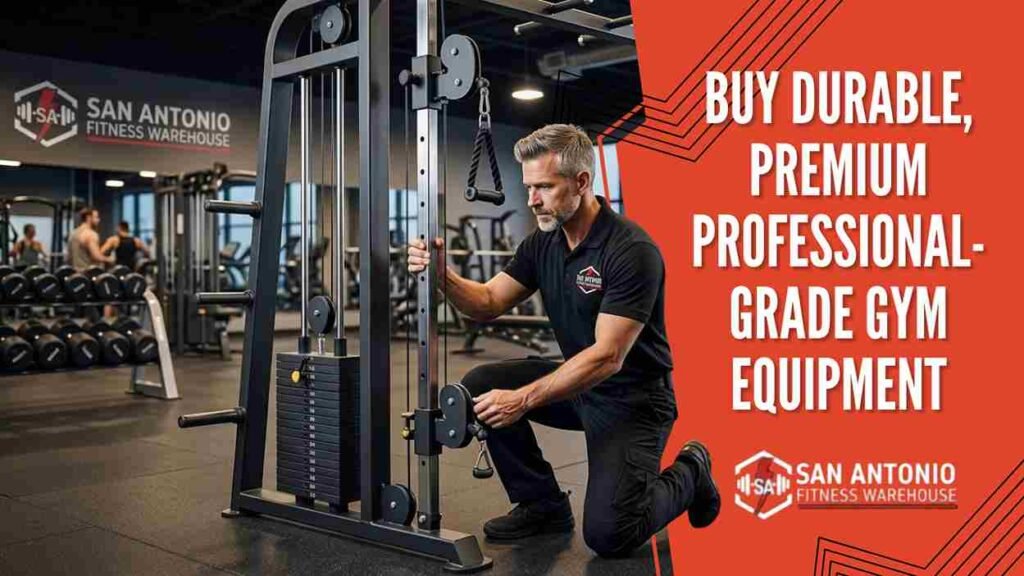
Buy durable, premium professional-grade gym equipment
When equipping a commercial gym in highly competitive markets, the phrase “built to last” appears in absolutely every supplier catalog. However, in the day-to-day fitness industry, the technical reality is often very different from marketing promises. Investing in the wrong equipment doesn’t just cause premature aesthetic wear that ruins your business image; it can empty your pockets through constant repairs, corrective maintenance, or, in the worst-case scenario, cause a catastrophic structural failure during a user’s routine.
For a gym owner or investor, equipment is not an expense—it is an asset that must generate returns for years to come. If you want to ensure you are making a smart, profitable, and safe investment, you need to learn how to identify true professional-grade gym equipment through 4 fundamental pillars of engineering and heavy-duty manufacturing.
1. The Thickness Test: Demand 11-Gauge Steel
The fastest, most reliable, and visible indicator of a machine’s real lifespan is the thickness of its structural metal. While residential or low-end equipment (designed to be used a few hours a week) utilizes 14 or 16-gauge steel, which consists of thin and light metals, a heavy-duty commercial environment demands professional-grade gym equipment strictly manufactured with 11-gauge steel across all weight-bearing stations and main supports.
- The Deep Technical Fact: 11-gauge steel has a real nominal thickness of 3.05 mm. Although a one-millimeter difference might seem insignificant on paper, under the laws of physics and material strength, this specific thickness offers drastically higher torsional and structural rigidity than any thinner alternative in the cheap commercial market.
- What to Look For (The Floor Test): When users lift maximum weights on a leg press or a power rack, the machine’s frame must not wobble, creak, or vibrate at all. If the frame flexes, even imperceptibly to the human eye, the powder-coated paint will begin to suffer micro-cracks. Through these microscopic cracks, environmental sweat moisture enters, rust begins to corrode the metal from the inside, and welded joints will eventually give way sooner or later. True professional equipment feels completely solid and anchored like a rock from the very first second of use.
2. The Metal’s “Birth Certificate” (MTR)
Steel quality cannot be measured solely by a superficial glance or by running your hand over the equipment. Behind an excellent layer of glossy, textured, or brightly colored paint, scrap recycled metal, low-density commercial steel, or defective alloys can easily be hidden, making the structure highly brittle under dynamic loads. For this reason, certified professional-grade gym equipment always come with strict documentary backing to verify their pedigree.
- How to Protect Your Investment Legally? Do not just take the salesperson’s word for it. Always formally ask your supplier for the MTR (Mill Test Report). This technical document is, quite literally, the chemical and origin certificate of the steel straight from the foundry.
- The Perfect Chemical Balance: For steel to be structurally strong yet allow welds to fuse perfectly, it needs a microscopic, precise balance of carbon. Too much carbon makes the metal brittle (and under a heavy impact, it can snap like glass); too little carbon makes it too soft (causing it to bend like lead under pressure). Additionally, essential alloying elements like manganese and silicon must be verified, as they improve metal deoxidation. If a supplier avoids giving you this report or makes excuses, distrust them immediately: you are not buying professional-grade gym equipment, you are buying “mystery metal”.
3. Visual Inspection: The Secret is in the Welds
A strength or selectorized machine is only as strong as its weakest joint. It is absolutely useless for a factory to boast about using the best imported steel in the world if the final pieces are only superficially “glued” or joined together through cheap labor or deficient automated processes. When physically evaluating and inspecting professional-grade gym equipment, reviewing the welds is your best diagnostic tool.
- Look for the MIG Welding (GMAW) Signature: Walk around the machine, bend down, and closely observe each of the critical frame joints. You should look for clean, continuous weld beads with a uniform geometric pattern that resembles a series of small, well-defined waves or scales. This proves there was an even heat distribution during manufacturing.
- Red Flags and Danger Alerts to Avoid: Steer completely clear of equipment that shows welds with “undercuts” (which are grooves or cracks burned directly into the base metal) or that have a porous, sponge-like appearance. Porosity means air bubbles became trapped during the cooling process, weakening the joint from within. A superior-quality fusion penetrates deep into the base metal, joining two separate pieces to transform them into a single, monolithic, and indestructible structure.
4. Structural Memory: Resiliency Against Time
Incessant and heavy commercial use generates a phenomenon known as constant microscopic stress on metals. Every time a weight plate drops, every impact on the safety stops of a Smith Machine, and every heavy repetition forces mechanical components to work to their limit. Authentic professional-grade gym equipment stand out from the competition due to a superior physical property: their excellent resiliency, commonly called “structural memory”.
- The Long-Term Mechanical Effect: Premium commercial-grade steel has the molecular capacity to absorb heavy impact energy and immediately return exactly to its original shape without suffering deformations. On the contrary, low-quality or fast-fatiguing steel begins to suffer from what engineers call “permanent set” or microscopic stretching. Over the months, the frame becomes irreversibly misaligned.
- The True Test of Time: This is the exact difference between acquiring professional-grade gym equipment whose alignment, movement axes, pulley biotypes, and bearings feel as smooth and perfect after 10 years of daily use, and buying budget equipment that starts to feel “loose,” misaligned, noisy, or unstable just a few months after cutting your fitness club’s grand opening ribbon.
Smart Buyer Summary: A machine’s visual aesthetics can easily be imitated with a good coat of automotive paint or eye-catching cushions, but internal engineering durability does not lie. Before signing any equipment contract or making a down payment, protect your investment: demand 11-gauge structural steel, request the corresponding MTR chemical certificates, and personally inspect the cleanliness of the welds. Your reputation, your members’ safety, and, above all, your long-term wallet will thank you.